
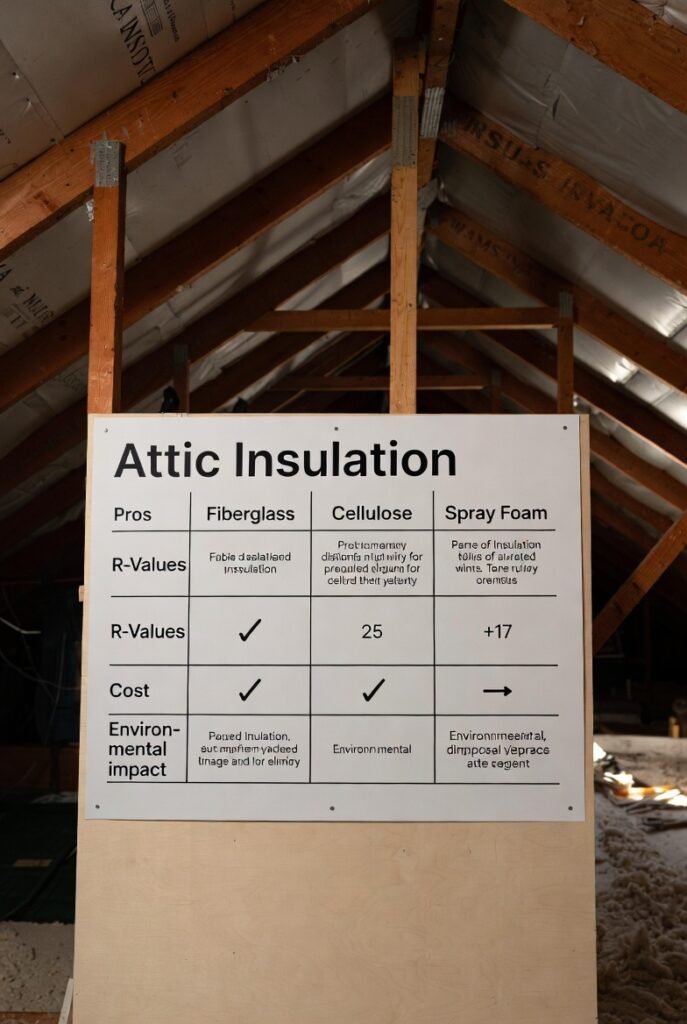
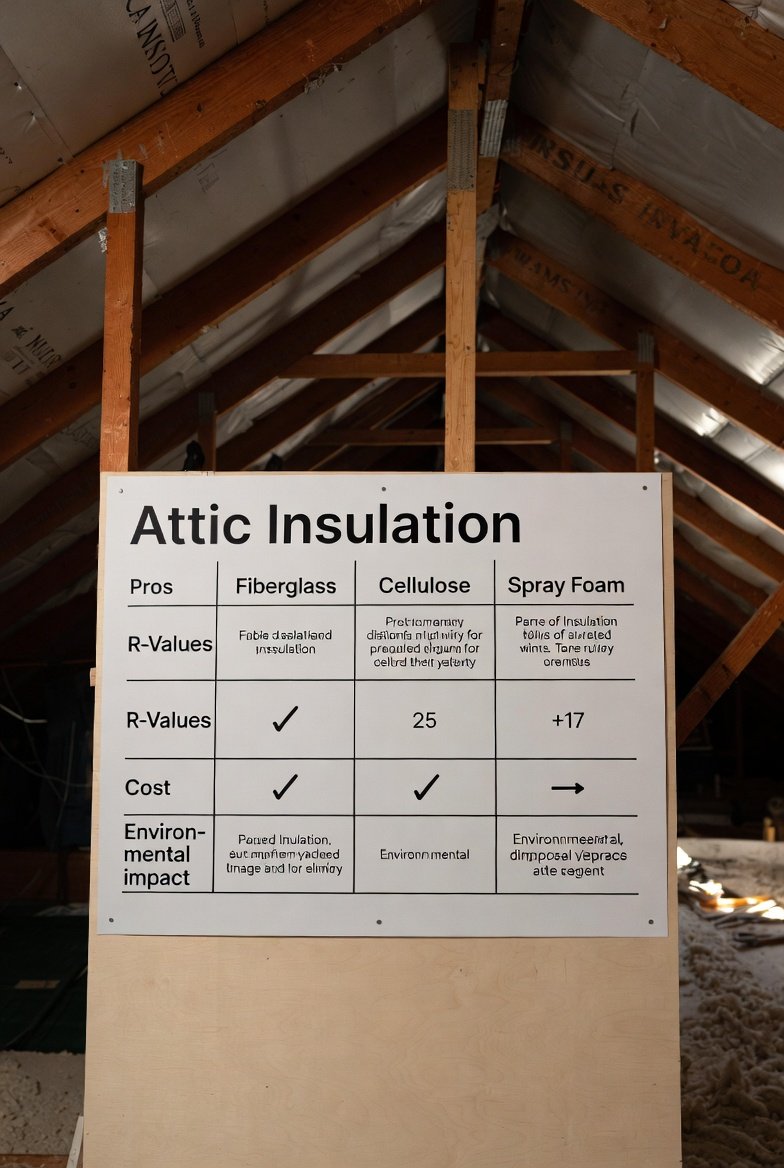
Attic Insulation Types
Quick Verdict
For most vented attics, blown-in fiberglass or cellulose is the best “coverage-for-dollar” choice — if you air seal first and protect soffit vents so nothing gets blocked.
What This Page Covers (and Doesn’t)
Covers:
Attic insulation types, insulation material pros and cons, “best attic insulation” decision logic, and attic insulation vs wall insulation (why the rules differ). Includes a verification checklist and a decision matrix.
Doesn’t cover:
Exact local pricing, brand recommendations, or DIY instructions that disturb hazardous materials.
Proof Widget — Scope Beats Material
(Skin: Field-Receipt | Structure B)
Claim
DOE / Building America notes sealing major attic air leaks should be done before adding insulation so leaks aren’t buried and inaccessible. (energy.gov)
What you choose | What decides results
Any insulation type | Air sealing + ventilation protection + verified coverage
Spec — Ventilation clearance
BASC specifies a minimum 1-inch clear airflow path from soffit vents, extending at least 6 inches above insulation height (use baffles / wind blocking). (basc.pnnl.gov)
Verify
Require photos proving baffles are installed at eaves and soffit intake paths aren’t buried after installation.
✅ Operator truth: The best material loses to a bad install.
Jump Links (Fast Navigation)
- Attic type first (vented vs conditioned)
- Comparison table (snippet-ready)
- R-values & depth cues
- Verification steps
- FAQs
1) Start Here: Vented Attic vs Conditioned Attic
This single choice controls which insulation types make sense.
A) Vented attic (most homes)
Insulation sits on the attic floor. The attic stays outside the conditioned space. Your job is to:
- keep soffit intake airflow open
- air seal the ceiling plane
- install continuous coverage at target depth
BASC vented-attic guidance includes keeping a clear airflow path from soffits using baffles / wind blocking. (basc.pnnl.gov)
✅ Operator truth: In a vented attic, blocked soffits is the quiet failure.
B) Conditioned / unvented attic (less common)
Insulation moves to the roof deck (often spray foam). This is a design change, not a material swap.
✅ Operator truth: “Foam = better” is not a plan. Assembly design is the plan.
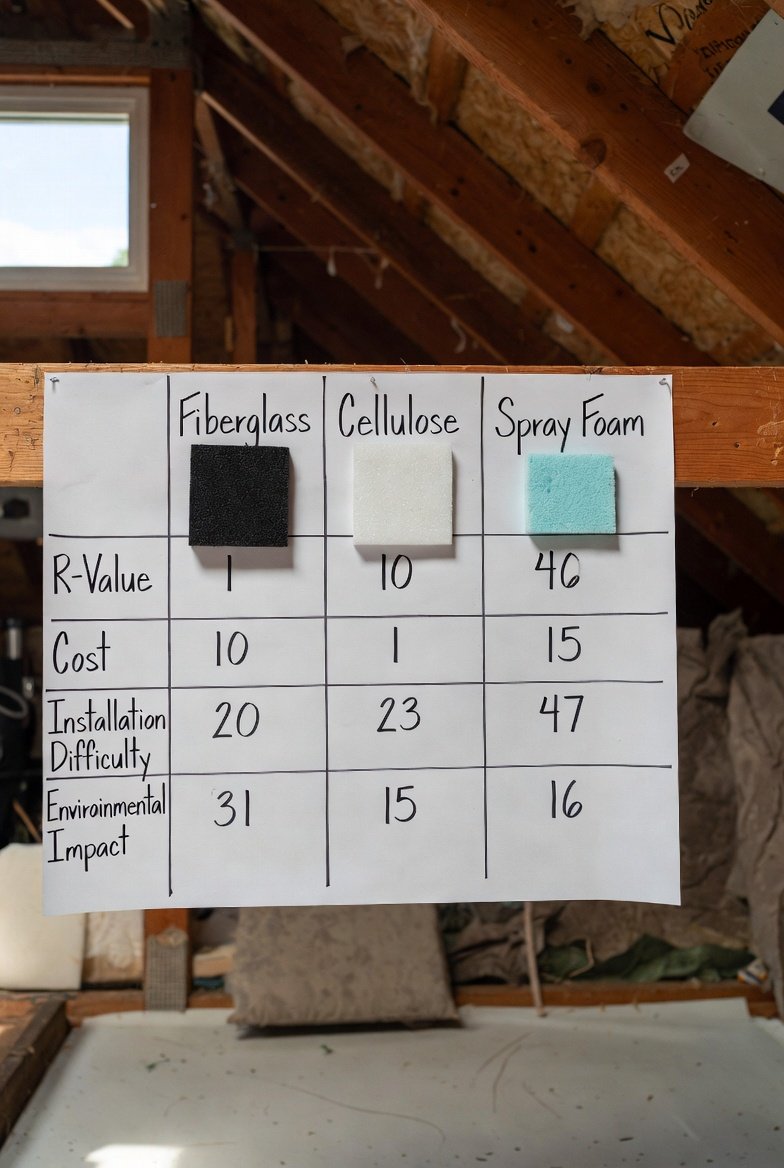
2) Attic Insulation Comparison (Snippet-Ready)
Material | Best use | Pros | Cons | Verification step |
Fiberglass batts | Open joist bays | Low cost, accessible | Gaps & compression kill R-value | Full contact + no voids |
Blown-in fiberglass | Most vented attics | Continuous coverage | Uneven depth risk | Depth markers + photos |
Cellulose (blown-in) | Obstacle-heavy attics | Fills around obstructions | Moisture sensitive | Moisture scan + even depth |
Spray foam | Roof-deck designs | Air seal + insulate | Cost + design-sensitive | Assembly + safety verification |
Rigid foam boards | Hatches / details | Strong thermal break | Not primary blanket | Seal edges + airtightness |
3) Main Attic Insulation Types (Real Pros & Cons)
A) Fiberglass Batts
Best when: clean, open joist bays
Fails when: compressed, stuffed, or edge-gapped
✅ Operator truth: Batts fail from bad installs, not bad material.
B) Blown-In Fiberglass
Best when: you want continuous coverage
Fails when: depth isn’t measured or eaves aren’t protected
✅ Operator truth: Blown-in wins when depth is verified, not guessed.
C) Cellulose (Blown-In)
Best when: many obstructions
Fails when: moisture exists
✅ Operator truth: Cellulose doesn’t fail — moisture does.
D) Spray Foam (Open / Closed Cell)
Best when: properly designed roof-deck assembly
Risks: attic insulation cost, moisture trapping, safety scope
✅ Operator truth: Foam without design = expensive regret.
E) Rigid Foam Boards
Best for: hatches, knee walls, detail work
Fails when: edges aren’t sealed
✅ Operator truth: Powerful in details, weak as a blanket.
4) Typical R-Values + Depth Cues
Approximate R-value per inch:
- Fiberglass: ~R-2.2 to R-3.7
- Cellulose: ~R-3.2 to R-3.8
- Spray foam: higher per inch, assembly-dependent
(energy.gov)
Depth cue:
“Enough” = measured depth that matches scope, with no thin spots and vents protected.
✅ Operator truth: Don’t argue R-value. Verify depth.
5) Non-Negotiables (Every Insulation Type)
A) Air Sealing First
DOE / Building America notes sealing major attic leaks should come before insulation. (energy.gov)
High-impact targets:
- top plates
- plumbing penetrations
- wiring holes
- open chases
- attic hatch
✅ Operator truth: Insulation slows heat. Air sealing stops drafts.
B) Ventilation Baffles (Vented Attics)
BASC requires:
- 1-inch clear airflow path
- channel extends 6 inches above insulation
(basc.pnnl.gov)
Vent protection checklist:
- ✅ Baffles installed
- ✅ Soffits not buried
- ✅ Air channel visible
✅ Operator truth: Blocked soffits fail later — that’s why they’re expensive.
6) Verification Steps (How-To Ready)
BASC checklists emphasize verification, not assumptions. (basc.pnnl.gov)
Verify in this order:
- Air sealing completed (photos)
- Baffles installed (eave photos)
- Depth markers placed
- Final photo packet (wide + detail shots)
✅ Operator truth: No proof = no quality control.
7) Operator Mistake → Consequence → Fix
Mistake: Blown-in insulation installed without baffles or sealing
Consequence: Comfort plateaus, drafts remain, ventilation compromised
Fix: Re-scope: baffles → seal → depth markers → photos
(basc.pnnl.gov)
8) Cost / ROI Logic (Without Pricing Tables)
- Batts: cheap material, performance depends on install
- Blown-in fiberglass: strong coverage value
- Cellulose: good coverage, moisture-sensitive
- Spray foam: higher cost, right only in correct assemblies
✅ Operator truth: Value = performance after verification.
9) Attic vs Wall Insulation (Quick Logic)
- Attics: big open plane, easy to verify, high ROI
- Walls: enclosed cavities, harder to verify
✅ Operator truth: If you do one upgrade, start with the attic.
10) FAQs (Snippet Targets)
Which attic insulation is best for most homes?
Blown-in fiberglass or cellulose in vented attics, when air sealing, baffles, and depth verification are included.
How do I prevent blocked soffit vents?
Install baffles and verify airflow remains open above final insulation depth. (basc.pnnl.gov)
Is spray foam better?
Only in the right design. Not automatically better.
The most common mistake?
Skipping air sealing and ventilation protection, then not verifying depth.
How do I verify coverage?
Depth markers, photo packet, and walkthrough of eaves and hatch.
Conclusion: Decision Matrix
Best overall:
Blown-in fiberglass or cellulose + air sealing first + baffles + depth markers + photo verification. (energy.gov)
Best value:
Blown-in fiberglass with strict depth verification.
Highest risk:
Any insulation installed with no sealing plan, no baffles, and no proof. (basc.pnnl.gov)
CTA:
Download the Printable Attic Insulation Decision Matrix to compare bids and scopes.