
Eco Insulation
“Eco insulation” is a broad term.
It can mean:
- High recycled content
- Renewable or bio-based material
- Lower chemical exposure
- Lower embodied carbon
- Durable performance that avoids waste
In attics, sustainability is not just about material origin.
It’s about correct assembly, moisture control, and long-term performance.
If insulation fails because of moisture or poor air sealing, it ends up in a landfill — eco label or not.
This guide focuses on attic-specific eco options and their limits.
What Qualifies as Eco Insulation in Attics
An insulation material typically qualifies as “eco” when it meets one or more of these criteria:
- Contains significant recycled or renewable content
- Has low chemical emissions after installation
- Is durable and moisture-resilient
- Performs well enough to reduce operational energy demand
The U.S. Department of Energy notes that cellulose insulation typically contains 82–85% recycled paper content.
insulation materials
Fiberglass and mineral wool often contain recycled glass or slag materials as well.
types of insulation
Those numbers matter more than vague “green” marketing.
Attic-Only Framing: Floor vs Roof Deck
Before comparing materials, clarify where insulation is going.
Vented attic (attic floor insulation)
- Thermal boundary is at the ceiling plane
- Ventilation remains active
- Air sealing is critical before adding insulation
Unvented attic (roof deck insulation)
- Thermal boundary moves to roof line
- Vent strategy changes
- Vapor control becomes more important
Air sealing fundamentals:
attic air sealing
Eco performance depends heavily on which assembly you’re building.
Mainstream Eco Insulation Options (Attic Focus)
1. Cellulose Insulation
Why it qualifies as eco
- 82–85% recycled newspaper content (DOE)
- Treated with fire retardants
- Widely available
Best used for
- Blown attic floor applications
- Retrofitting existing vented attics
Not ideal if
- Roof leaks are unresolved
- Chronic moisture exposure exists
- Installer density is inconsistent
Cellulose can absorb moisture.
That does not mean it fails automatically — but attic moisture control must be correct.
More on cost comparisons:
blown insulation cost
2. Fiberglass (Blown or Batt)
Eco profile
- Often includes 40–60% recycled glass (DOE range varies by manufacturer)
- Non-combustible
- Widely available
Best used for
- Attic floor insulation
- Cost-sensitive upgrades
Not ideal if
- Air sealing is incomplete
- Wind washing is present in attic floor cavities
Fiberglass does not stop air movement.
Air sealing must precede installation.
3. Mineral Wool (Rock Wool)
Eco profile
- Often contains recycled slag and stone content
- Fire resistant
- Hydrophobic compared to cellulose
Best used for
- Areas requiring higher fire resistance
- Applications where moisture tolerance matters
Not ideal if
- Budget is tight
- Large-scale blown attic coverage is needed at lowest cost
Mineral wool is less common in large attic floor retrofits but performs well in certain assemblies.
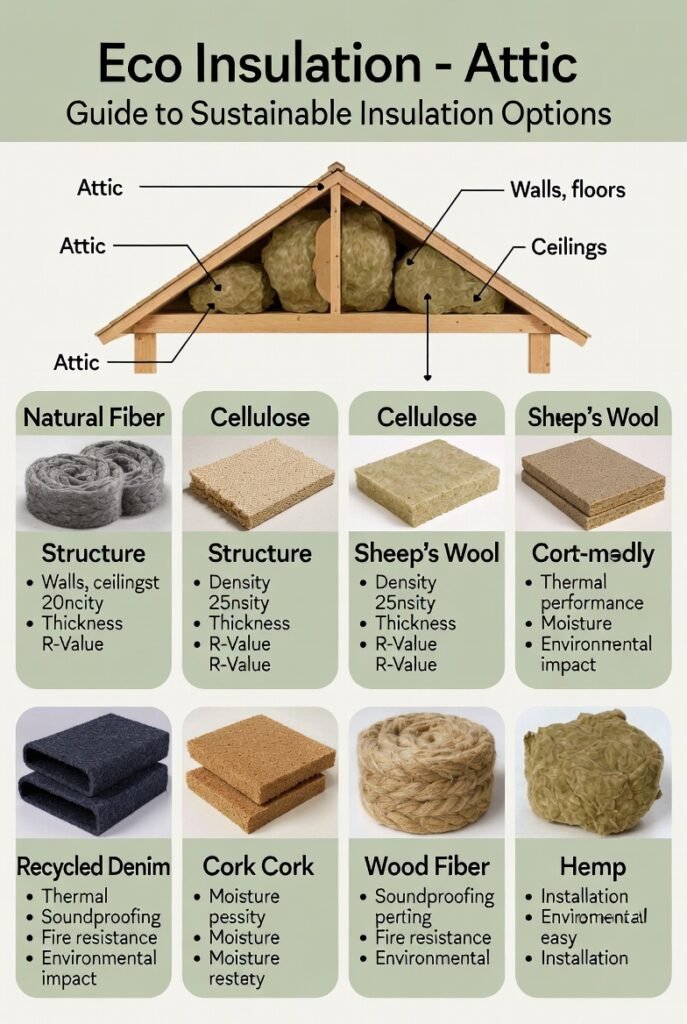
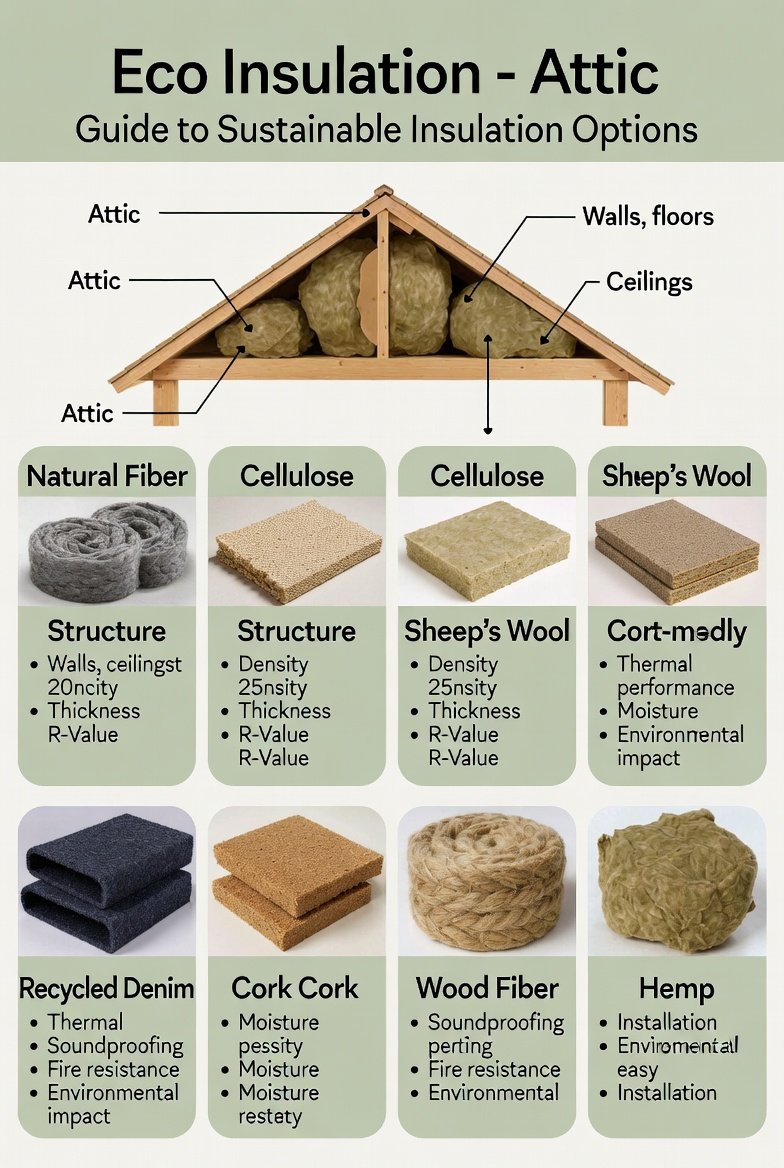
4. Sheep’s Wool, Denim, Hemp, Cork
These materials often appear in eco insulation lists.
Strengths
- Renewable or recycled origin
- Lower perceived chemical exposure
- Marketing appeal
Limitations
- Limited availability in some regions
- Higher cost
- May require special installers
- Moisture tolerance varies
Not all natural materials are automatically more durable.
Installation quality and assembly design matter more than material origin alone.
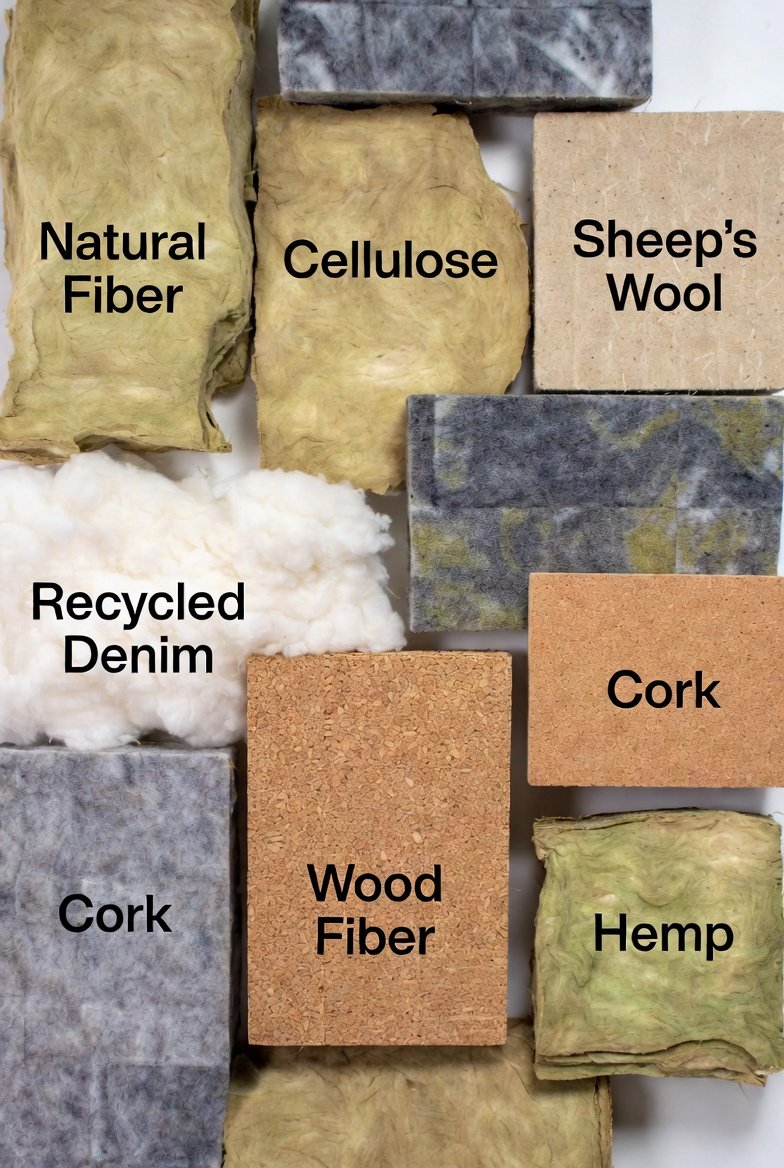
Eco Insulation Comparison — Attic Matrix
Material | Recycled/Renewable Content | Moisture Sensitivity | Best For | Not Ideal If |
Cellulose | 82–85% recycled (DOE) | Moderate | Vented attic floors | Roof leaks present |
Fiberglass | Often recycled glass content | Low to moderate | Budget attic upgrades | Air leaks unsealed |
Mineral Wool | Often recycled slag content | Lower moisture absorption | Fire-resistant zones | Large low-cost retrofits |
Wool / Hemp | Renewable | Variable | Specialty builds | Budget or installer limits |
This is an attic framing guide — not a full wall or whole-house evaluation.
Moisture Boundaries — Eco Does Not Override Physics
Insulation does not fix:
- Roof leaks
- Poor ventilation strategy
- Bulk water intrusion
- Improper vapor control
The EPA explains that sustained humidity above 60% can promote mold growth in enclosed spaces.
mold course chapter 2
If attic humidity is high, the root cause must be addressed before installing any insulation type.
Eco and Spray Foam — Clarification
Spray foam is often excluded from “eco” discussions.
However:
- Closed cell can improve air sealing and durability.
- Open cell can reduce air leakage.
Embodied carbon and chemical profile debates exist, but operational performance matters too.
Spray foam comparison:
open cell insulation
Foam cost context:
foam insulation cost
This page focuses on eco framing, not foam chemistry debates.
R-Value Still Matters
Eco does not replace performance targets.
DOE and ENERGY STAR provide attic R-value guidance by climate zone.
If a material cannot reach required R-value in available depth, it may not be appropriate — even if renewable.
When Eco Insulation Is Not the Right Priority
Choose performance-first if:
- Moisture problems exist
- Ventilation imbalance remains unresolved
- Air sealing has not been completed
- Roof condition is uncertain
In many cases, air sealing first + appropriate attic floor insulation is the most sustainable path.
Ventilation fundamentals:
attic ventilation tips
Decision Shortcut
If you have a vented attic floor:
- Cellulose or fiberglass are commonly practical eco options.
If you prioritize high recycled content:
- Cellulose is a leading mainstream choice.
If fire resistance and moisture tolerance matter:
- Mineral wool may align better.
If you want fully renewable materials:
- Confirm installer availability and climate suitability before committing.
Pause installation if:
- Moisture source is unknown
- Air sealing is incomplete
- Vent strategy is unclear
Balanced Perspective
Eco insulation is not a material category.
It’s a performance + sourcing conversation.
The most sustainable attic system is:
- Properly air sealed
- Correctly ventilated (if vented assembly)
- Adequately insulated to climate targets
- Installed at correct density and coverage
Material origin matters.
Assembly durability matters more.
FAQ
What is eco insulation?
Eco insulation typically refers to insulation materials with recycled or renewable content and lower environmental impact, used within a properly designed building assembly.
Is cellulose the most eco-friendly insulation?
Cellulose has high recycled content (82–85% per DOE), making it a strong mainstream eco option for attic floors.
Is fiberglass considered eco insulation?
Fiberglass often contains recycled glass content and can qualify as eco depending on manufacturing and installation context.
Does eco insulation prevent mold?
No insulation prevents mold if moisture problems exist. Mold control depends on humidity management and moisture control.
Is natural insulation better than synthetic?
Not automatically. Performance, moisture tolerance, installation quality, and climate compatibility determine long-term results.