
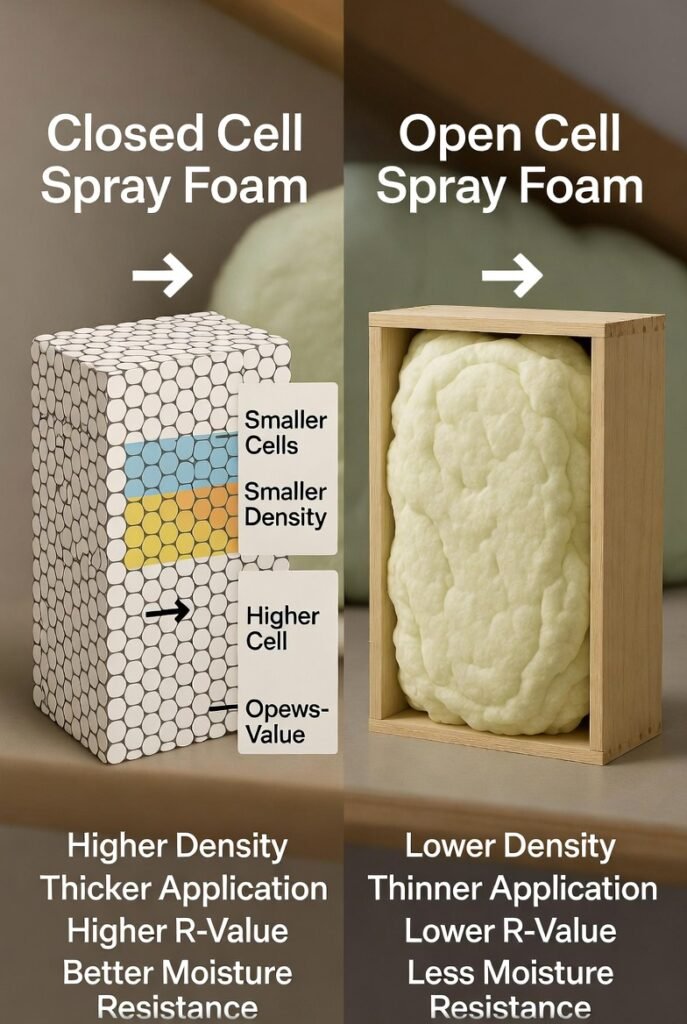
Closed Cell vs Open Cell Insulation
Closed cell and open cell spray foam are not interchangeable upgrades. They change how an attic, wall, or crawl space manages air, vapor, and drying.
The correct choice depends on:
- Assembly type (roof deck vs wall vs rim joist)
- Climate zone
- Moisture risk
- Required R-value
- Long-term roof and maintenance plans
This guide compares both materials clearly, without oversimplifying the building science behind them.
Quick Comparison Table
Property | Open Cell Foam | Closed Cell Foam |
R-value per inch | ~R-3.5 to R-3.8 | ~R-6 to R-7 |
Density | Low | High |
Vapor permeability | Permeable | Low permeance (vapor retarder at thickness) |
Air sealing | Yes (when properly installed) | Yes (when properly installed) |
Structural rigidity | Minimal | Adds rigidity |
Sound reduction | Better | Moderate |
Cost (per board foot) | Lower | Higher |
For full cost modeling and board foot math, see:
foam insulation cost
Air Control vs Vapor Control
Both open and closed cell foam:
- Seal air leakage when installed correctly.
They differ in vapor behavior:
- Open cell allows more vapor movement and supports inward drying.
- Closed cell slows vapor diffusion significantly at typical thicknesses.
The U.S. Department of Energy explains that vapor retarder placement depends on climate and assembly design.
vapor barriers
Higher R-value does not override vapor strategy. Assembly design determines performance.
Roof Deck (Unvented Attic) — How to Decide
Spray foam at the roof deck:
- Moves the thermal boundary to the roof line
- Often changes traditional attic ventilation strategy
- Converts attic to conditioned space
Ventilation fundamentals:
attic ventilation tips
Open Cell at Roof Deck
Commonly used when:
- Climate is warm or mixed
- Budget constraints exist
- Interior drying potential is desired
Not ideal if:
- Cold climate with high condensation risk
- Roof leaks are possible and drying path is unclear
- Moisture risk has not been evaluated
Closed Cell at Roof Deck
Commonly used when:
- Higher R-value per inch is required
- Climate is cold and vapor control is important
- Structural rigidity is beneficial
Not ideal if:
- Roof may need near-term replacement
- Access for future deck inspection is important
- Scope excludes ignition/thermal barrier requirements
DOE Building America guidance discusses foam properties and assembly considerations.
Walls — Whole-Assembly Reality
Closed cell provides higher R-value per inch.
However:
- Wood studs create thermal bridging.
- Whole-wall performance depends on framing layout and installation quality.
Higher cavity R-value does not eliminate thermal bridging.
Open cell can perform effectively in wall cavities when assembly drying potential is appropriate.
Rim Joists
Closed cell is often selected for rim joists because:
- Space is limited
- Higher R-value per inch helps
- Vapor resistance is beneficial
Open cell can work but may require greater thickness to achieve similar performance.
Crawl Spaces
Closed cell is commonly used on foundation walls due to vapor control and durability.
Open cell may be used in specific assemblies but requires proper moisture strategy.
Moisture problems must be corrected before adding foam.
R-Value and Climate Zones
ENERGY STAR and DOE provide climate-based attic R-value guidance.
General patterns:
- Warmer climates: lower R-value targets
- Colder climates: higher R-value targets
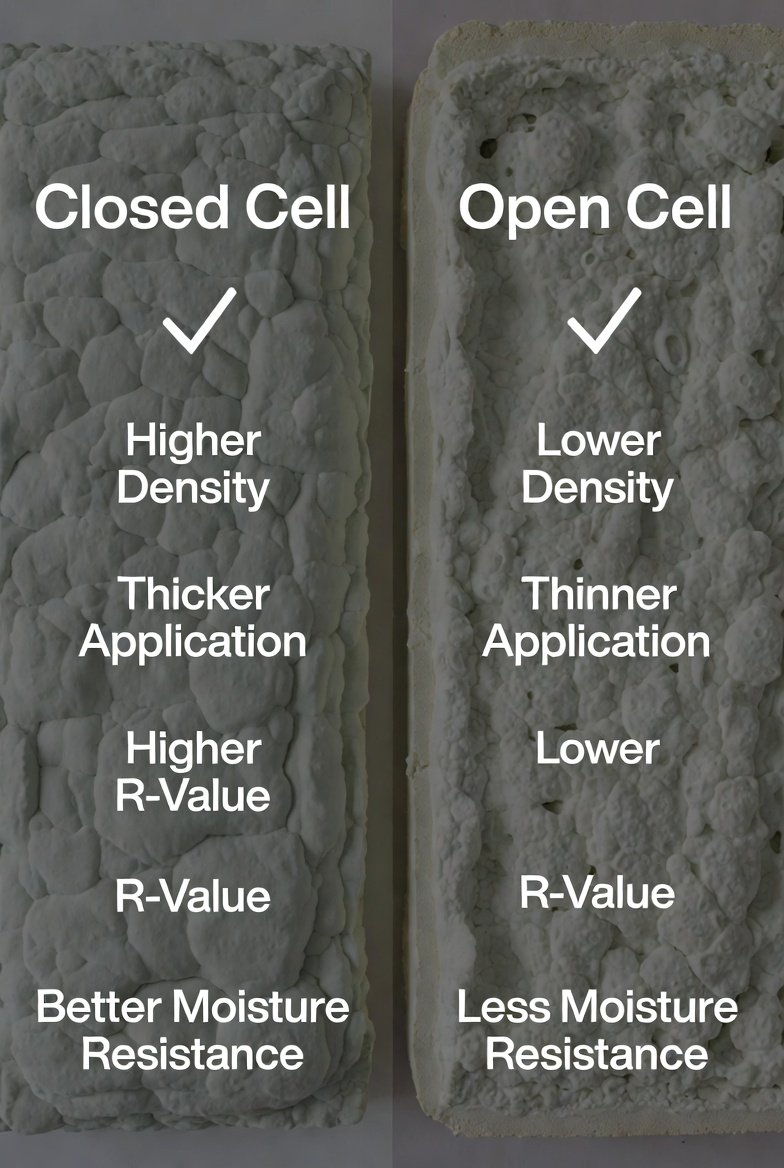
Closed cell may reach higher R-values in limited depth.
Open cell requires more thickness to reach the same total R-value.
Use R-value targets first, then determine thickness based on product R-value per inch:
R-Value chart
Moisture and Leak Behavior
Open cell:
- Allows more vapor movement
- May allow roof leaks to show more visibly
Closed cell:
- Slows vapor diffusion at thickness
- Can resist bulk water better
- May slow drying if incorrectly detailed
Neither product fixes bulk water intrusion. Roof integrity and ventilation strategy must be addressed separately.
Fire and Code Requirements
Both open and closed cell foam are combustible.
Depending on location and accessibility, code may require:
- Thermal barrier (e.g., drywall)
- Ignition barrier coating
Code requirements vary by jurisdiction and assembly type. Quotes should clearly state barrier strategy.
Discussion of ignition/thermal barriers:
thermal barriers
When Neither Is the Right Move
Spray foam may be unnecessary if:
- A vented attic only needs air sealing and additional attic floor insulation
- Moisture issues are unresolved
- Roof replacement is imminent
- Budget cannot support full encapsulation scope
For broader insulation comparisons:
material for attic
Decision Shortcut
Choose closed cell when:
- Higher R-value per inch is required
- Vapor control is critical in colder climates
- Space constraints exist
Choose open cell when:
- Drying potential toward interior is important
- Climate risk is moderate
- Budget is a constraint
Pause and evaluate assembly design if:
- Roof deck moisture risk is unclear
- Ventilation strategy has not been reviewed
- Air sealing has not been addressed
Air sealing fundamentals:
Attic air sealing
FAQ
Is closed cell better than open cell insulation?
Closed cell provides higher R-value per inch and greater vapor resistance, but open cell may offer better drying potential and lower cost depending on the assembly and climate.
Does closed cell act as a vapor barrier?
At sufficient thickness, closed cell functions as a vapor retarder, but proper assembly design and climate considerations remain critical.
Is open cell safe for attic roof decks?
It is used in many assemblies, but condensation risk and drying direction must be evaluated, especially in colder climates.
Which spray foam is better for cold climates?
Closed cell is commonly selected in colder zones due to higher R-value per inch and vapor control properties.
Can I mix open and closed cell foam?
It can be done intentionally in certain assemblies, but vapor behavior and drying direction must be evaluated before combining materials.
Is spray foam insulation worth it?
It can be appropriate when air sealing and assembly design justify it, but in some cases improving attic floor insulation is sufficient.