
Best Insulation Material for Attic
Let’s clear something up first.
Most “best insulation” articles are wrong.
They either:
- Push spray foam as a miracle solution
- Or rank materials by R-value alone
Neither approach helps you choose correctly.
The best attic insulation depends on:
- Climate zone
- Air leakage
- Moisture conditions
- Budget
- Whether the attic remains vented or becomes conditioned
And there’s one rule that overrides everything:
Air seal first. Insulate second.
If you skip that, no material performs as advertised.
You can see why sealing comes first in our guide to
👉Attic air sealing
Now let’s break this down properly.
Quick Decision Matrix
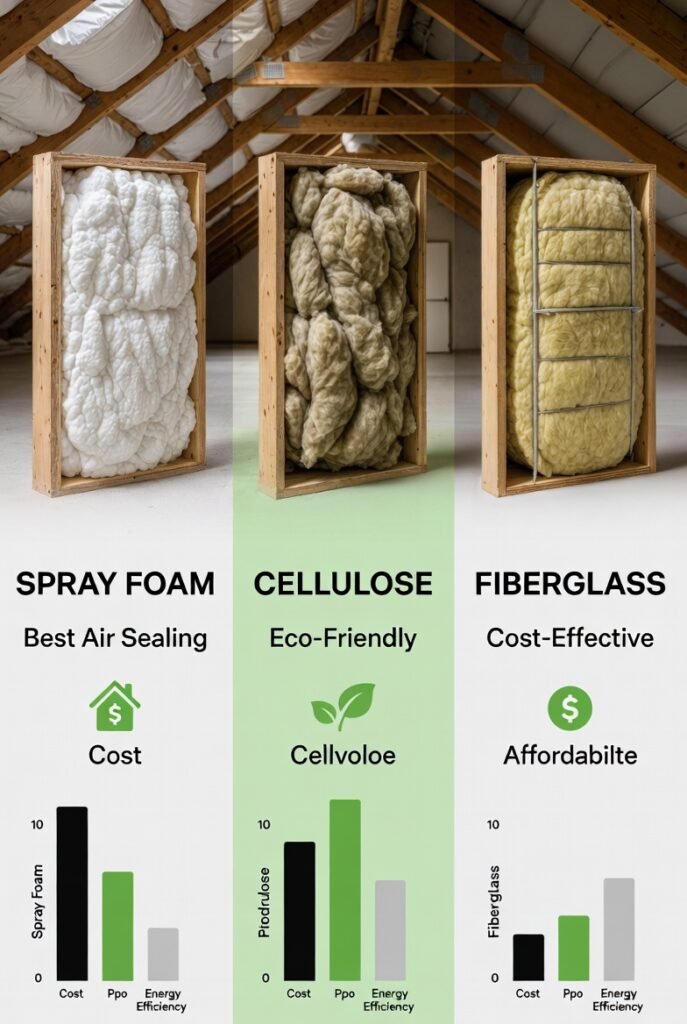
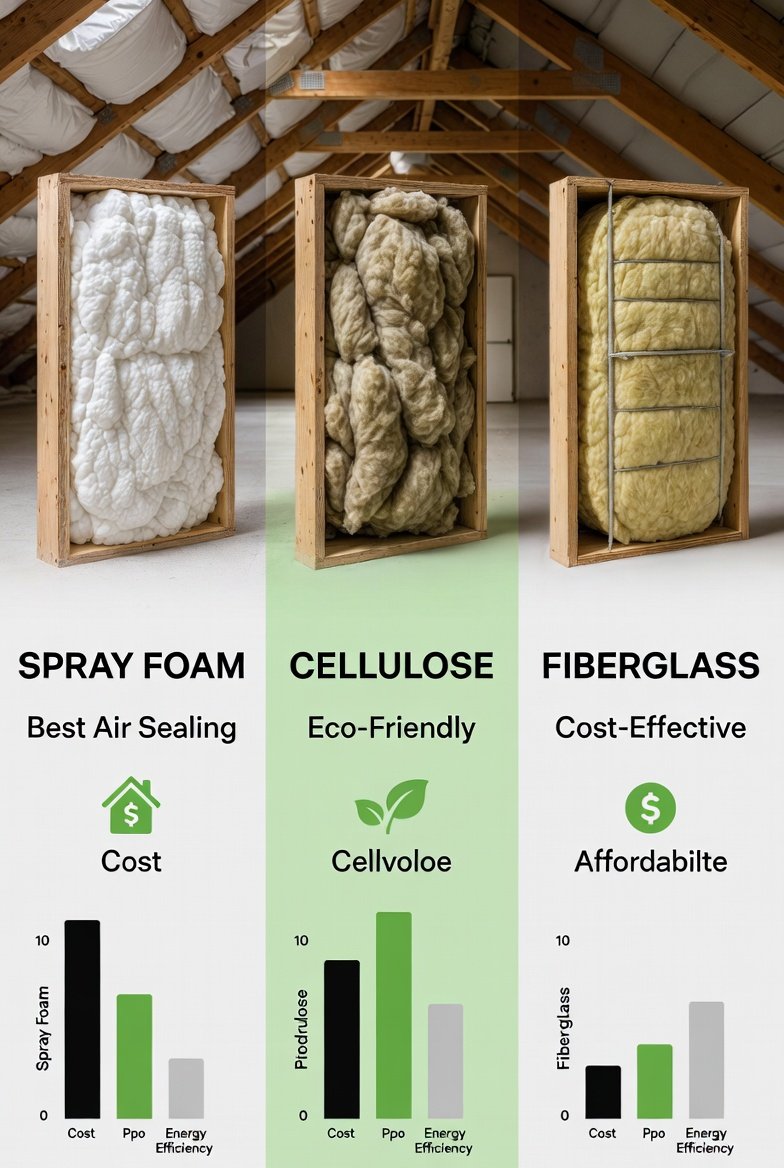
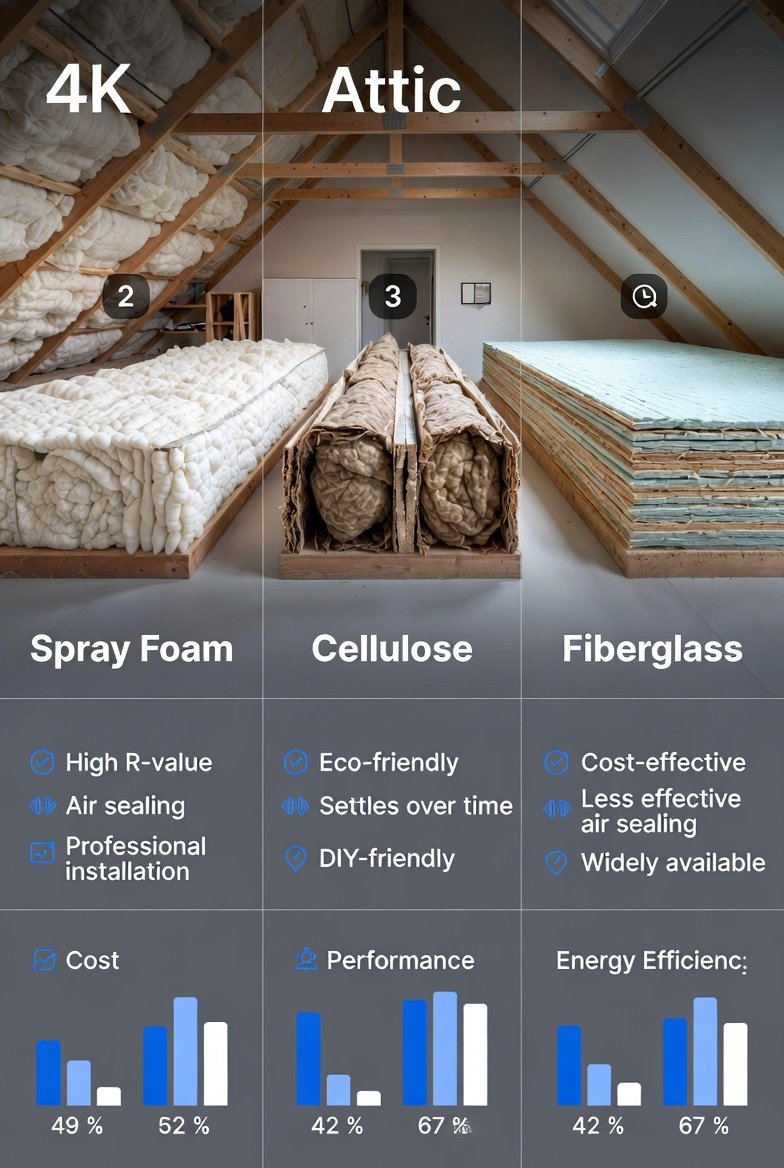
Material | R-Value / Inch | Relative Cost | Air Sealing | Moisture Tolerance | Best For |
Fiberglass Batt | 3.0–3.7 | Lowest | Low | Moderate | Budget top-ups |
Fiberglass Blown | 2.5–3.5 | Low–Moderate | Low | Moderate | Large open attics |
Cellulose | 3.2–3.8 | +10–20% vs fiberglass | Moderate | Moderate–Low | Irregular framing |
Mineral Wool | 3.0–3.3 | Moderate | Low | High | Fire/moisture resilience |
Open-Cell Foam | 3.5–3.8 | 3–4× fiberglass | High | Moderate | Air-leaky attics |
Closed-Cell Foam | 6.0–7.0 | 4–5× fiberglass | Very High | Excellent | Low clearance / conditioned attic |
Full pricing variables are explained here:
👉 insulation cost
Now let’s look at each material realistically.
1️⃣ Fiberglass (Batt & Blown-In)
Where It Wins
- Lowest upfront cost
- Easy to source
- Non-combustible
- Good for simple top-ups
Where It Struggles
- Does not air seal
- Performance drops if compressed
- Gaps reduce effectiveness
- Wind washing if baffles are missing
Not Ideal If…
- Your attic is leaky
- You have visible air gaps
- You’re trying to solve drafts
Quick verdict:
Best for budget upgrades in dry, properly sealed attics.
2️⃣ Cellulose (Blown-In)
Denser than fiberglass. Fills irregular cavities better.
Where It Wins
- Retrofit projects
- Older homes with uneven framing
- Better gap coverage
Where It Struggles
- Can absorb moisture
- May settle over time
- Requires balanced ventilation
If humidity is elevated, address it first:
👉 attic moisture solution
Not Ideal If…
- Your attic has active condensation
- Roof leaks aren’t resolved
- Ventilation is unbalanced
Quick verdict:
Strong retrofit performer — if moisture is under control.
3️⃣ Mineral Wool (Rockwool)
Often overlooked but extremely durable.
Where It Wins
- Fire resistance
- Moisture tolerance
- Sound control
Where It Struggles
- Heavier
- Higher cost than fiberglass
- Less common for full-floor attic coverage
Not Ideal If…
- You’re strictly budget-driven
- You need massive depth increases cheaply
Quick verdict:
Best for durability and fire resistance, not lowest cost.
4️⃣ Spray Foam (Open vs Closed Cell)
This is where misinformation spreads.
Spray foam is not “always best.”
It’s best for specific problems.
Where It Wins
- Severe air leakage
- Converting attic to conditioned space
- Complex framing
- Low cavity depth
Relative Cost Signal
- Typically 3–5× more expensive than fiberglass or cellulose installs.
Critical Safety Warnings
❌ Do NOT spray foam over recessed lights without proper clearance.
❌ Do NOT foam directly against flues or chimneys.
❌ Foam can eliminate ventilation if misapplied.
Ventilation strategy must be evaluated carefully:
👉 attic ventilation
Not Ideal If…
- You’re just increasing depth
- The attic should remain vented
- Budget is limited
Quick verdict:
Best for air-sealing-driven redesigns — not standard depth upgrades.
Why R-Value Alone Is Misleading
Higher R-value per inch doesn’t automatically mean better overall performance.
Example:
- Closed-cell foam has high R per inch.
- But if your attic is properly sealed and vented, blown insulation at correct depth can deliver excellent performance at far lower cost.
Depth + air sealing > product marketing.
Confirm proper thickness targets here:
👉 R-Value chart
Three Installation Mistakes That Destroy Performance
- Blocking soffit vents without installing baffles
- Compressing insulation under storage platforms
- Skipping depth markers during blown installation
Even the best insulation fails when installed poorly.
Decision Shortcut (Fast Map)
If your attic is:
- Leaky → Air sealing + possibly targeted foam
- Dry and open → Blown fiberglass
- Irregular framing → Cellulose
- Moisture-prone → Fix ventilation first, then consider mineral wool or foam
- Converting to conditioned space → Foam (properly designed system)
Simple.
Match the material to the problem.
Final Framework
Before choosing insulation:
- Inspect attic.
- Seal air leaks.
- Confirm ventilation path.
- Verify R-value target.
- Choose material based on layout and moisture profile.
Material is step five.
Not step one.
Frequently Asked Questions
What is the best insulation for attic floor?
For most homes, blown-in fiberglass or cellulose after air sealing offers strong performance at moderate cost.
Is blown-in insulation better than rolls?
Blown-in covers irregular spaces more evenly. Rolls are easier for DIY projects.
Is spray foam the best attic insulation?
Spray foam is best for severe air leakage or conditioned attic designs, not every home.
Can I add insulation over old insulation?
Yes, if existing insulation is dry and not contaminated.
Do I need a vapor barrier in my attic?
Most vented attics rely on ventilation rather than additional vapor barriers.
What R-value should my attic have?
Most homes require R-38 minimum; colder climates may require R-49 or higher.