
Attic Fan Installation Near Me: Hire Locally Without Creating New Attic Problems
People search “attic fan installation near me” because they want relief fast — heat upstairs, a roasting attic, or humidity that won’t quit.
Here’s the uncomfortable truth:
A powered attic fan is not just an install.
It’s a pressure and airflow decision.
If the installer doesn’t verify intake and airflow pathways, the fan can:
- pull conditioned air out of your house,
- worsen moisture movement in some climates,
- or simply do nothing meaningful except make noise.
This page is a fan-only national hiring guide.
No city pages. No fluff. Just a clean system to hire the right installer in your area.
For attic airflow fundamentals (quick read before you hire):
attic ventilation tips
TL;DR Decision Map
Proceed with hiring if:
- soffit intake exists and can be confirmed open,
- you can describe your attic layout and vent types,
- you know whether this is a replacement or a new cut-in.
Pause and diagnose first if:
- insulation is clearly below target depth,
- there’s visible moisture, staining, or musty odor,
- bathroom vents might be dumping into the attic,
- you don’t know whether intake vents exist.
If you need a system-level pro first, use this hiring guide:
attic ventilation contractors
What “Attic Fan Installation” Usually Includes
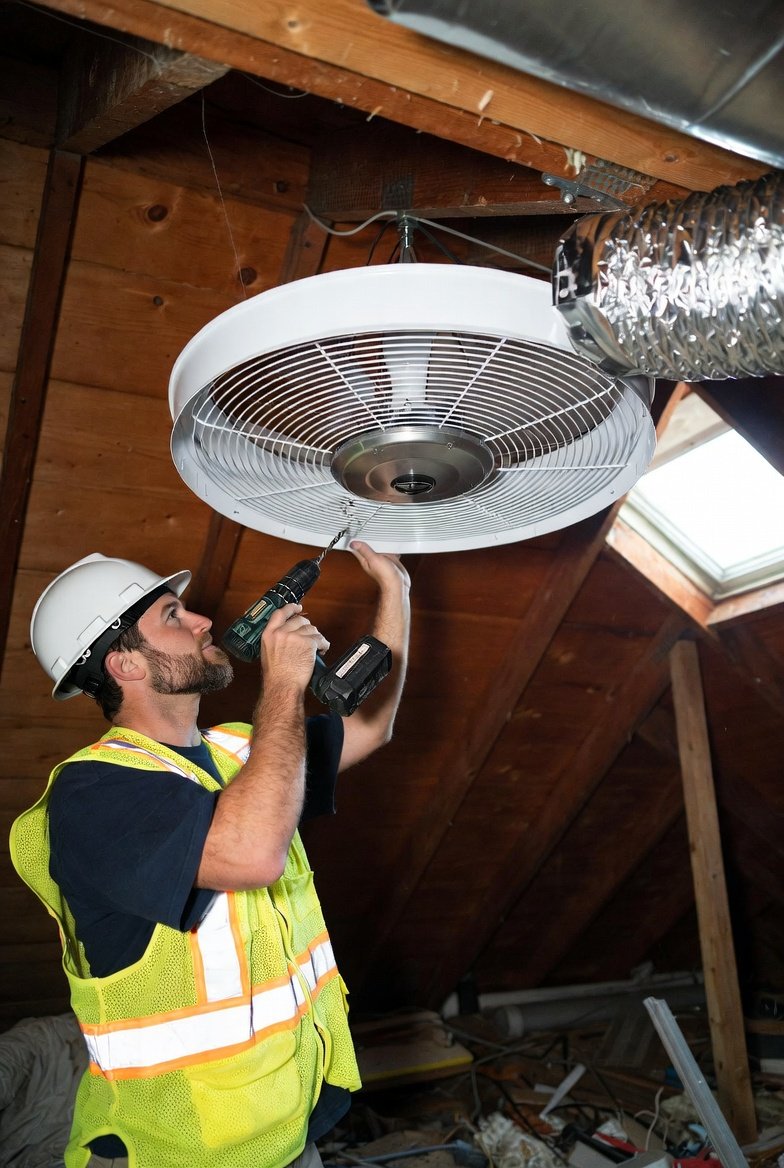
A proper installation typically involves:
- selecting fan type and location,
- cutting and mounting (roof or gable),
- wiring (unless solar),
- controls (thermostat / humidistat),
- verifying airflow path (intake → attic → exhaust),
- sealing/flashing and weatherproofing (roof units).
Some jobs require multiple trades (roofing/carpentry + electrical) depending on scope.
Step 1: Decide What You’re Installing
Roof-Mounted Electric Attic Fan
Best for: roof-only exhaust locations, standard attics
Installer profile: roofer (mounting) + electrician (wiring)
Common failure mode: installed without adequate soffit intake
Gable-Mounted Attic Fan
Best for: gable-end attics with clear airflow path
Installer profile: carpenter/handyman + electrician
Common failure mode: short-circuit airflow or poor placement
Solar Attic Fan
Best for: simpler installs when electrical tie-in is expensive
Installer profile: roofer (mounting and flashing)
Common failure mode: “solar = no problem” myth (intake still matters)
Step 2: Intake Gate Before You Pay Anyone
This is where most “near me” installs go wrong.
A powered fan needs makeup air. That usually comes from soffit vents.
If intake is blocked or insufficient, the fan will pull air from wherever it can — including ceiling penetrations from the conditioned space.
Your installer should explicitly confirm:
- soffit vents exist,
- baffles keep insulation from burying intake,
- airflow path is not blocked at the eaves.
If you want the short version: intake matters more than fan size.
Quick Pricing Reality Check Near Me
Most “near me” pages push averages. You don’t need a perfect number — you need a range tied to scope.
- National sources commonly cite typical install ranges around the mid-hundreds to low-thousands, with many projects falling under $1,000 and higher-end installs reaching ~$1,500+ depending on unit and complexity.
- Install Q&A pages also cite a normal range roughly $370–$920 with an average around $625 (again: scope-dependent).
- Home improvement service pages describe pricing varying by fan type/location and break out labor vs unit cost.
For a deeper scope-based cost breakdown on your site:
attic fan installation cost
The “Near Me” Hiring Funnel That Works
Step A: Search the right contractor type
Use this filter:
- Roof-mounted fan: roofer + electrician capability
- Gable fan: carpentry + electrician capability
- Solar roof fan: roofer with roof-penetration experience
Step B: Require three things before an on-site quote
- Intake check plan
- Wiring scope explanation
- Weatherproofing/flashing plan (roof units)
If they can’t explain those in plain English, don’t book.
Copy/Paste Call Script (Use This on the Phone)
Say this:
“I’m looking for attic fan installation. Before we book, I need to know three things: do you verify soffit intake is open, do you handle the electrical hookup or coordinate it, and what’s your plan for flashing/sealing if it’s roof-mounted. Also, is this priced as replacement vs new cut-in.”
If the answers are vague, they’re not a system installer.
Quote Checklist: What a Good Quote Includes
A good quote lists:
- Fan type (roof/gable/solar) + model category
- Whether it’s replacement or new cut-in
- Electrical scope (existing circuit vs new run)
- Control type (thermostat/humidistat)
- Intake verification steps (soffit/baffles)
- Roof details (flashing method, shingle integration)
- Warranty on labor + manufacturer warranty on unit
If the quote is one line (“install attic fan $X”), that’s a risk.
Red Flags That Predict a Bad Install
- “We install fans same day, no inspection needed.”
- No mention of soffits or intake.
- They oversell savings or guarantee results.
- They recommend the biggest fan immediately.
- They can’t explain what happens if intake is blocked.
- They dismiss insulation and air sealing as unrelated.
This niche is full of fast installs. Your job is to avoid becoming a case study.
What to Check Yourself Before the Installer Arrives
Attic access
- clear hatch area
- stable ladder setup
- safe walking path (boards if needed)
Vent identification
Try to answer:
- Do you have soffit vents
- Do you have ridge vent
- Do you have gable vents
- Is there an existing fan opening
If you have insulation piled into the eaves, you may be intake-blocked.
When Not to Install a Fan Yet
If insulation depth is clearly low
Fans do not replace insulation performance.
Check targets first:
R-Value chart
If air sealing is clearly incomplete
Sealing top-plates, penetrations, and hatch gaps matters for performance and moisture control.
Use this guide:
attic air sealing
If moisture source is unknown
A fan won’t fix roof leaks or mis-vented bathrooms. Diagnose first.
Fan Type vs Contractor Type Matrix
Fan type | Best installer | Why |
Roof-mounted electric | Roofer + electrician | Roof penetration + wiring |
Gable-mounted electric | Carpenter/handyman + electrician | Framing + wiring |
Solar roof fan | Roofer | Flashing + placement |
If a contractor is missing the trade needed for your scope, expect delays or shortcuts.
Mini Scenarios (So You Can Self-Select)
Scenario 1: Replacement roof fan
Existing opening and wiring are present.
This is usually the easiest “near me” job to hire out.
Scenario 2: New roof-mounted fan
This requires cutting, flashing, wiring, and intake verification.
This is where bad installs happen.
Scenario 3: Hot upstairs but unknown attic setup
This is not a “buy a fan” moment.
It’s a “confirm insulation + sealing + passive vents” moment.
For system-level hiring guidance:
attic ventilation
Quick Verdict
If you want attic fan installation near you, hire locally — but only after intake is verified and the installer can explain airflow logic.
A good installer doesn’t sell a fan.
They sell a safe airflow outcome with a clear scope.
FAQs
How do I find attic fan installation near me without getting ripped off
Use a hiring filter: require intake verification, a clear electrical scope, and a flashing/sealing plan for roof fans. Avoid one-line quotes.
What contractor installs an attic fan
Roof-mounted fans are typically handled by a roofer (mounting) plus an electrician (wiring), or a contractor who coordinates both. Some installs require multiple pros.
How much does attic fan installation usually cost
Many projects fall in the high-hundreds range, with typical ranges often cited under $1,000 and higher-end installs reaching around $1,500+ depending on scope and fan type.
Do I need soffit vents before installing an attic fan
A powered fan needs makeup air. If intake is blocked or missing, performance drops and pressure issues can occur.
Is solar attic fan installation easier
Solar can reduce electrical work, but roof penetration, sealing, placement, and intake verification still matter.
Will an attic fan fix a hot upstairs
Not always. If insulation depth is low or air sealing is poor, you may get better results addressing those first.
How long does installation take
Replacement installs are often a few hours; new cut-ins with wiring and roof work can take half a day or longer depending on complexity.